
Prime demand sits here. Units are assigned and topped up against Amazon's own receiving windows.

Stock in place, orders moving daily
Availability wins marketplaces. This page describes how stock, warehouse replenishment, FBA prep, and order fulfillment are handled for brands distributed through Omniflex Supply LLC with Omnifex Agent coordination. The goal is steady: no long stockouts on core SKUs, no surprise prep fees, no oversell across channels.
Operations coverage
Every pallet is counted before it moves.
Onboarding through Omniflex Supply LLC puts a US sales channel under your brand without building one. The fulfillment layer is where a wholesale relationship either holds steady or starts leaking — stock that misses a receiving window, prep that fails Amazon spec, quantities that drift across three sales channels. Omnifex Agent coordinates those moving parts so a manufacturer or brand owner can plan around them instead of chasing them.
What follows is the working method, band by band: how inbound cartons are checked, how FBA prep is built to Amazon spec, how replenishment is planned per SKU, how stock stays synced across Amazon FBA, Walmart Marketplace and TikTok Shop, how returns and problem stock are handled, and what we need from you on every carton.
 Section 01 — Inbound
Inbound: from factory to US floor
You ship to the agreed US inbound point per delivery terms. We confirm cartons, counts, and labeling against the packing list. Palletized replenishment often moves less-than-truckload, where providers such as XPO operate. Damage or shortage is documented with photos before stock is booked.
Good inbound makes everything downstream cheaper. We spend time here.
That means: verifying case quantities against the packing list line by line, checking label placement and scannability, photographing any crushed corner or short case before it disappears into the rack, and confirming the pallet count before the truck is released. A shortage found at the dock is a claim; the same shortage found three weeks later is a loss.
Prep spec
FBA prep, done to Amazon spec
FBA prep services include FNSKU labeling, poly-bagging and suffocation warnings where required, bundling, expiration-date handling for applicable categories, and carton and pallet labeling. Shipments are created in Seller Central with the correct Amazon routing. Prep mistakes create receiving holds. We avoid them by checking pack data before the truck is booked.
Small detail with large effect: correct case pack counts on the first shipment.
What prep covers
- 01 FNSKU labeling on every sellable unit
- 02 Poly-bagging and suffocation warnings where required
- 03 Bundling and multi-pack preparation
- 04 Expiration-date handling for applicable categories
- 05 Carton and pallet labeling matched to Seller Central routing
 Section 02 — Replenishment
Reorder math
Replenishment planning by SKU
SKU replenishment uses recent velocity, seasonality noted by your team, factory lead time, and Amazon receiving time. Core SKUs carry deeper cover. Test SKUs carry light cover. Reorder signals go out with enough lead time to produce and ship.
We do not inflate orders to hit freight minimums. We combine SKUs sensibly and tell you why.
What goes into a reorder signal
Velocity
Recent sales run rate on the SKU across every channel it is listed on
Seasonality
Peaks your own team knows about, so cover lands before the demand does
Factory lead time
Production and freight time from your plant to the US floor
Amazon receiving time
The window between shipment creation and units showing as available
Safety stock
A buffer per channel that absorbs a spike without going to zero
Inventory sync
Inventory sync across channels
Inventory sync assigns on-hand and inbound units to Amazon FBA, Walmart Marketplace or WFS, TikTok Shop, and DTC overflow where applicable. Quantities update on a schedule and after major sales events. Safety stock per channel absorbs spikes. Oversell usually comes from one shared pool. We do not run one shared pool.
Catalog mapping supports this. One SKU, one mapping, counted in each location.
Walmart orders are served with their own pool where WFS is in use, so the Amazon number stays whole.
TikTok demand swings fast. A dedicated quantity keeps a spike from draining core skus.
Your own storefront draws from a fourth pool, so a direct spike does not touch marketplace stock.
Channel mix
FBA, WFS, and 3PL in one plan
FBA covers Amazon Prime demand. WFS covers Walmart Marketplace orders where used. A US-based 3PL such as ShipBob covers DTC and overflow with distributed warehousing and inventory visibility. That is why brands outsource fulfillment when channel mix gets complicated: one team cannot pick, pack, and prep for three rulebooks without help.
Larger multi-node needs may reference contract logistics such as DHL Supply Chain. Parcel moves and pallet moves are planned separately.
Per-unit orders, direct to the buyer
Single units picked, packed, and shipped to a customer address. Prep spec, label, and carrier are chosen per channel — Amazon FBA, Walmart Marketplace, or your own storefront. Parcel cost is quoted before the shipment, so freight minimums never decide the order size.
- Per-channel prep spec
- Tracking on every order
- Return address set for each channel
- Damaged units pulled before they ship
Cartons moved in bulk to a channel
Case-packed cartons moved by the pallet to Amazon, Walmart, or a 3PL — combined across SKUs where the combined pallet still meets the destination's routing rules, and left whole when it does not.
Returns desk
Returns and problem stock
Returns are inspected under marketplace rules. Defective units are segregated. Resellable units return to available stock. Reimbursement claims in Seller Central are filed where Amazon policy allows, with case IDs tracked. Patterns, like a loose cap or weak seal, go back to your factory team quickly.
Fast feedback here protects review ratings and reduces repeat returns.
Segregate
Defective units come out of sellable flow the moment they are identified.
Reclaim
Reimbursement claims are filed where marketplace policy allows, with the case reference held for you.
Report back
Repeat patterns — a loose cap, a weak seal, a short seam — go to your team before they compound.
Carton standard
What we need on every carton
These four items decide whether receiving takes hours or days. If packaging needs changes for US retail, we specify them before production.
-
Item 01
Compliant barcodes
Scannable as printed. If a barcode will not read at the dock, it will not read at the pack line.
-
Item 02
Accurate case quantities
The count on the outside matches the count inside. Every case, every delivery.
-
Item 03
Visible lot or exp data
Where the category requires it, the lot or expiration data is on the case and legible.
-
Item 04
No mixed SKUs in a sealed case
Unless pre-agreed. Mixed cases slow receiving and confuse inventory counts downstream.
Column one
On hand by location
Every unit accounted for at the location that actually holds it — FBA, WFS, 3PL, or in transit between them.
Column two
Inbound with tracking
Purchase orders in motion, each with a shipment reference and an expected receiving window, so nothing disappears between factory and floor.
Column three
Reserved, safety, next reorder
Reserved units, the safety buffer per channel, and the next suggested reorder — read in one pass so a decision can be made without a call.
Visibility you receive
Monthly stock report, plain.
Monthly stock report: on hand by location, inbound with tracking, reserved and safety stock, and next reorder suggestion. Sales and payout reporting is covered on the Brand Control and Reporting page and summarized here for planning. Questions go to Omnifex Agent at +1-302-555-0184.
Address on record: 1209 Orange St, Wilmington, DE 19801, USA. Domain: omnifex-agent.com.
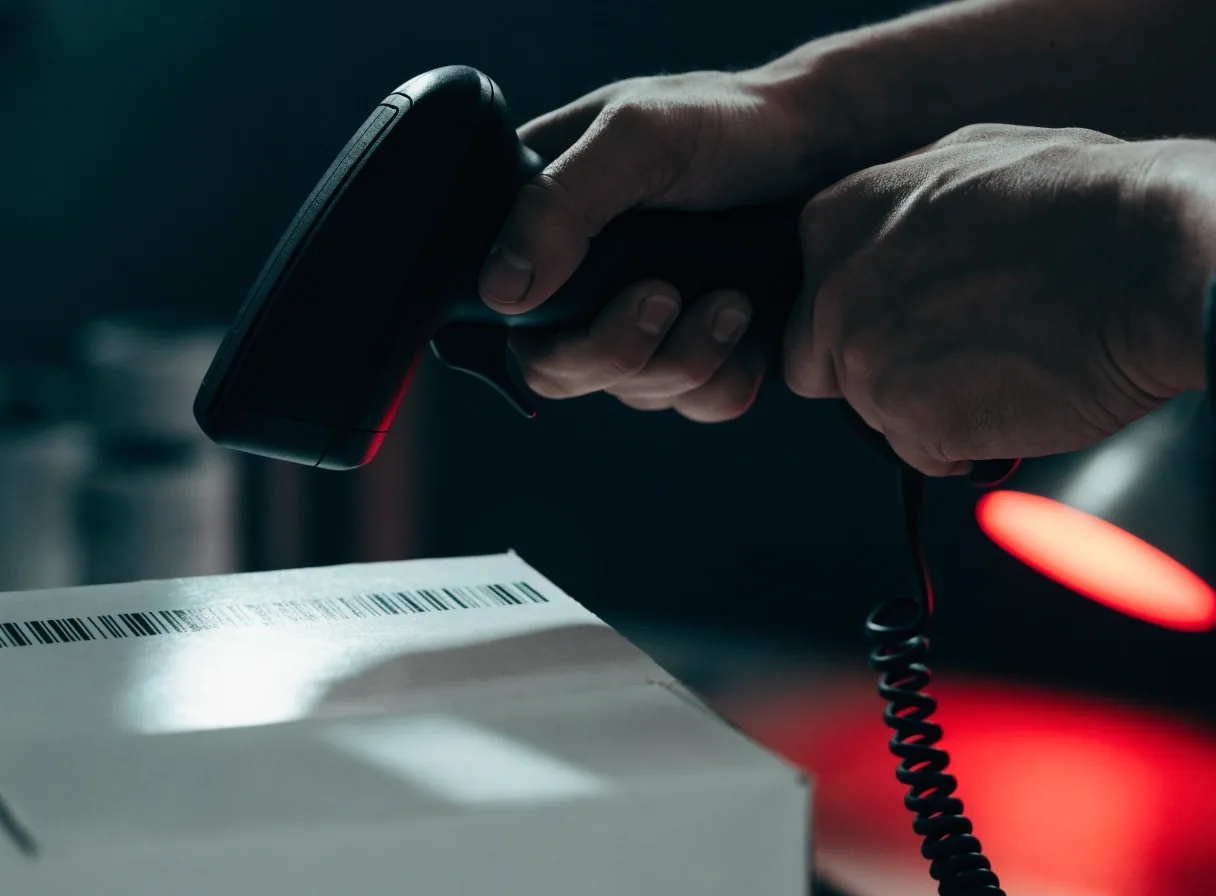
Scanner station — one barcode, one count, at a time
 Section 03 — Steady state
Steady state
What steady availability looks like
Steady is easier to describe in the negative. It is not a warehouse full of everything; it is the right cover on the right SKUs, moved before the last case leaves the shelf. It is not a stack of prep holds at Amazon receiving; it is a shipment created once, labeled right, and booked at the correct routing.
A brand distributed through Omniflex Supply LLC with Omnifex Agent coordination usually sees the same three changes in the first two months of live selling: receiving holds drop out of the cycle, the reorder conversation moves from emergency to planned, and cross-channel quantity stops being a weekly argument and starts being a number on a report.
The four working rules
-
Verify before you book
Cartons, counts, and labels checked against the packing list before stock is recorded as available.
-
Prep to the channel's spec
FNSKU, poly-bag, bundle, and carton labeling built the way the destination requires, not the way the last shipment did it.
-
Plan the reorder, don't react to it
Signals go to your team with enough lead time to produce and ship; the emergency order is the signal that the plan failed.
-
Keep each channel's pool whole
Quantity is assigned per channel with a safety buffer, so an oversell on one channel is not a stockout on another.
Where this continues
Two pages that pick up from here
- Brand Control and Reporting How listings, prices, and brand presentation are held steady, and how monthly sales and payout reporting is delivered.
- How Onboarding Works The intake sequence a manufacturer walks through, from product review and wholesale terms to first live shipment.
- Amazon and Marketplaces Where listings are created, catalogued, and connected to the stock that this page keeps moving.